Law & Lawyers

Deal Friction

Why the green grid might do better without open access.

Are the Feds at war with green power development? You might have thought so, if you had sat through the conference held March 15, 2011, at the Federal Energy Regulatory Commission, where the consensus seemed to be that FERC’s policy of granting open-access rights on electric transmission lines is problematic for green power projects. In short, when wind and solar developers choose to build their own local tie lines to link their projects to the larger grid, FERC policy forces them to make extra line capacity available to rival developers. That requirement doomed the novel Wind Spirit Project, and continues to complicate the job of project financing.

The Art of the Plausible

Prospects for clean energy legislation in 2011.

With budget battles heating up in Washington, Congress and the Obama administration are squaring off to debate energy policy legislation. While Democratic leadership favors a clean energy standard, Republican lawmakers are focused on blocking administration initiatives to regulate greenhouse gas emissions. A compromise approach might bring substantial changes to America’s national energy strategy.

Frontiers of Efficiency

What conservation potential assessments tell us about ‘achievable’ efficiency.

Regulators across the country are relying on conservation-potential assessments to guide their policy decisions. Models based on macroeconomic analysis, end-use forecasting and accounting measurements provide different ways to assess the achievability of conservation and efficiency goals.

Tax Burdens and Barriers

Where tax rates are too high, grid investments suffer.

As the industry works to modernize the national T&D infrastructure, utilities are investing dollars that ultimately increase their cost of service—and therefore end-use prices. To cover their investments, many companies are taking a close look at their tax-management policies.

Grid Futures

Evolutionary directions for electric system architecture.

How will the technology and policy changes now sweeping through the industry affect the architecture of the utility grid? Will America build an increasingly robust transmission infrastructure, or will we rely more on distribution intelligence and microgrids? Scholars at California’s Institute for Energy and Environment analyze various scenarios to predict the possible futures.

Transactions (April 2011)

FirstEnergy closes $4.7 billion stock acquisition of Allegheny Energy; BHP Billiton agreed to by shale gas interests from Chesapeake Energy; Capital Power to acquire gas-fired cycle power plants from Brick Power Holdings and others.

Vendor Neutral

(April 2011) GE Hitachi and Lockheed Martin team up on nuclear reactor controls; Elster wins metering contract in New Hampshire; Xcel hires Bechtel for nuclear services in Minnesota; Mitsubishi builds transformer HQ in Memphis; Northeast Utilities taps Siemens for transmission projects; Iberdrola sells wind output to FirstEnergy; Consumers and DTE invest $400 million to upgrade pumped storage facility; plus contracts and announcements from Alstom, URS, Areva, groSolar, Pattern Energy, S&C Electric and others.

People (May 2011)

Entergy Corp. names vice president of federal governmental affairs; Black Hills fills two executive positions; plus senior staff changes at Alliant Energy, First Wind, UniSource Energy, Consumers Energy, Midwest ISO, and others.

Green Transition

Integrating distributed resources into the smart grid.

The remedy for America’s gravest economic woes may lie in a smart grid that can deliver vast amounts of clean, renewable energy while enhancing our energy security and democratizing our energy system. Although regulatory questions and technical challenges might dominate the industry’s short-term focus, the smart grid’s driving forces parallel America’s long-term national interests — a fact that should guide ongoing technology strategies and investment decisions.

Seismic Omen

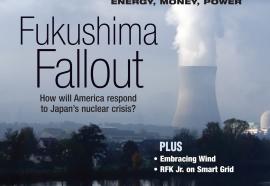
Fukushima shockwaves hit America’s nuclear renaissance.

In the aftermath of the March 11 earthquake and tsunami, questions are arising about the safety and survivability of reactors located in geologically active areas. Major changes might be required, and as a result the U.S. nuclear industry might face an existential challenge on the order of the Three Mile Island accident.