Law & Lawyers

Long-Term Transmission Rights: A High-Stakes Debate

The absence of long-term transmission rights could exclude potential competition—and cause higher electricity costs.

Power-industry restructuring redistributed financial uncertainties that discourage generation investment and ultimately raise the price of electricity to consumers.


LNG's Final Hurdle

Interchangeability issues threaten to delay vitally needed LNG projects.

Gas composition issues have become a significant hurdle for the industry. Resolving these challenges will not be easy, requiring all stakeholders to apply a thoughtful approach to understanding the issues.

After EPACT: A Mad, Mad Scramble for Talent

The Energy Policy Act of 2005 makes human resource challenges even more significant.

Hidden in the 1,700-plus pages of the Energy Policy Act of 2005 is a set of regulatory requirements that will redefine the technology, leadership, training, culture, compensation, job design, and organizational models currently employed in the industry.

The Art of Gas Storage Valuation

Benefits and drawbacks of the most popular estimation methods or modeling techniques.

Before we go about trying to value natural-gas storage, we should try and come up with a list of important considerations in any valuation process. Also, the data requirements should be modest, and the calculation time should be reasonable. But not all gas storage valuations are created equal.

East Vs. West: Growing the Grid

The models and motives behind tomorrow’s transmission expansion.

Major transmission projects based on two distinct models are showing signs of life. What can these projects teach us about future transmission investment?

The Key to California's Coal Future

Don’t overlook high-quality, project-based emissions reductions.

By Mike Burnett and Bjorn Fischer

Mike Burnett is executive director of the Climate Trust. Bjorn Fischer is business development manager at the Climate Trust. Contact Fischer at bfischer@climatetrust.org. The Climate Trust is a non-profit committed to providing high quality, project-based reductions and advancing the policies that support them. Its offices are located in Portland, Ore.

Energy Hedge Funds: Market Makers or Market Breakers?

Should utilities and consumers be concerned about these obscure investment groups?

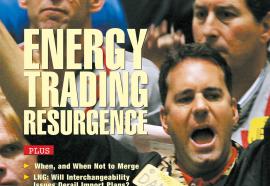
The total hedge-fund universe currently approaches $1.1 trillion, about 5 percent of which is dedicated exclusively to energy. These numbers for energy hedge funds are likely to grow at unprecedented rates. How can your company benefit?

“Mysterium tremendum et fascinans”: The Latin phrase, coined by German theologian Rudolf Otto, which characterizes humans as being overwhelmed and fascinated by experiences that are totally different from ordinary life.1

Special Section On Metering: Needed in New England: Stronger Market Connections, Savvier Electricity Usage

The region’s retail and wholesale electricity markets should be linked via dynamic pricing.

The time has come to start the transition from the current economic demand-response programs to demand response that arises naturally through market-based retail pricing.

Over the past few decades, utility sponsored conservation and load-management programs have helped thousands of customers better manage their energy costs. While these programs have helped lower overall electricity use, they generally have not provided an economic incentive for customers to reduce their consumption at specific times in response to wholesale electricity prices.

A Hard Look at BPL: Utilities Speak Out

After closer study of the technology’s ongoing implementation and obstacles, the crystal ball remains cloudy.

What will it take for broadband over power line (BPL) technology to take hold? Is BPL on track to become, as the National Association of Regulatory Utility Commissioners (NARUC) once contemplated, the “third broadband pipe into residential consumers’ homes, providing significant competition for cable and DSL service,” and an integral part of the 21st century “smart grid”?

A Primer on Hedge Funds

“Hedge funds … are unregistered private investment partnerships, funds, or pools that may invest and trade in many different markets, strategies, and instruments (including securities, non-securities, and derivatives) and are NOT subject to the same regulatory requirements as mutual funds, including mutual fund requirements to provide certain periodic and standardized pricing and valuation information to investors. There are substantial risks in investing in Hedge Funds.”1