
Rate Shock: A Matter of If, or When?
In the near future, the majority of investor-owned electric utilities will request, and ultimately win, rate increases. What can utilities do to alter consumer perceptions of higher bills?


In the near future, the majority of investor-owned electric utilities will request, and ultimately win, rate increases. What can utilities do to alter consumer perceptions of higher bills?

The way senior tech executives and business managers define success has changed.
Alignment of the business and the information technology (IT) functions within a company is critical to the effectiveness of any strategic initiative. Three years ago, our research identified a number of best practices in IT integration, as they affected M&A execution. What changed, according to our new survey, is the way senior IT executives and senior business managers define success in a merger transaction. With so much at stake in any merger, the distinctions between these two important management constituencies are critical.

Some supplies may not make it to U.S. ports.
With the dramatic growth of the liquefied natural gas (LNG) trade worldwide and increased dependence on LNG as the gas fuel of the future, gas-utility companies at the end of the chain need to question whether the LNG chains are still safe, reliable, and well managed. But before diving in to some of the risks, it should be pointed out that historically LNG chains have been safe.
We must efficiently deliver wholesale power within competitive regional markets.
When President Eisenhower was growing up in Kansas, he saw America’s byways and back roads develop to meet point-to-point needs, eventually forming a loosely connected national interstate highway network. The U.S. electric transmission system has similar roots, and it needs a similar vision to meet the needs of the 21st century.
RTOs in the region continue to struggle.
Efforts to develop more RTOs in the West came to a near standstill again after talks last year among key players Bonneville Power Administration (BPA), Grid West, and the Transmission Improvements Group collapsed over BPA’s convergence proposal. The end of talks is one more failure in a long line of failures to find consensus on an RTO approach in the West. Grid West is attempting to reorganize following BPA’s withdrawal, but its fate is indeterminate. Key issues are funding for continued development and achieving agreements with BPA and other transmission providers in the region.
Jim Lundrigan, New Haven, Conn.: After reading Gordon van Welie’s article (“New England: A Critical Look at Competition,”) I couldn’t help but think back to California in 2000. Van Welie, who is president and CEO of ISO New England, is trying to feed the citizens of New England the same brand of malarkey that the California ISO fed the California Public Utilities Commission in 2000 when wholesale and retail prices in California were perfectly linked and nearly succeeded in bankrupting the wealthiest state in the country.
John S. Ferguson, Richardson, Texas: The article of Michael J. Majoros Jr. (“Rate-Base Cleansings: Rolling Over Ratepayers,”) attracted my attention, because I perceive it to propose a solution—PUCs’ need to recognize refundable regulatory liabilities—for a problem that does not exist.
(January 2006) Kathleen Chagnon joined Saul Ewing LLP as a partner in its business department. Sierra Pacific Resources announced that Donald D. Snyder was elected to its board of directors. Avista Corp. named Linda M. Jones director of corporate communications. Allegheny Energy Inc. named Loyd (Aldie) Warnock vice president, external affairs. And others...
FERC this year must select a reliability czar. But the obvious choice could prove less than ideal.
NERC up until now has been, in its own words, “a self regulatory organization, relying on reciprocity, peer pressure, and the mutual self-interest of all those involved in the electric system.” Nevertheless, can this tradition of kind, gentle, and voluntary consensus-building stand NERC in good stead as it seeks to transform itself in to a steel-fisted czar that would enforce mandatory standards?
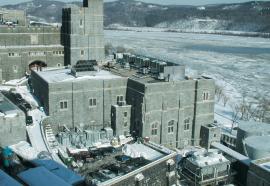
Could local generators be used either to regulate voltage or control the power factor on distribution systems in New York?
Reactive power is becoming a hot issue in many regions of the country. Regulators and grid operators are grappling with ways to account fairly for reactive power supplies, and to encourage such resources to come online where they are needed. These analyses, however, are largely ignoring a vast fleet of infrastructure already installed on the network. West Point military academy, for example, has four small synchronous generators that are used for combined heat and power or emergency power applications. If these generators also were used as synchronous condensers, they might supply additional revenue to pay for the distributed energy investment.

How to avoid the billions of dollars in costs that were disallowed during the last round of construction.
With nuclear energy again being viewed as part of the solution for the United States’ energy needs, a number of companies are starting the early permitting and licensing process. Meeting budget targets means the industry must address project-management issues and the risk of end-of-project disallowances for any company or regulator to be able to move forward with new construction.