

NARUC Summer Policy Summit
Ann Rendahl is the current President of NARUC, leading the organization of state utility regulators and serving on its Executive Committee and Board. She is also a commissioner on the Washington Utilities and Transportation Commission (UTC), first appointed in 2014 and reappointed through January 2027. Rendahl participates in key industry groups, including the Southwest Power Pool’s Markets+ States Committee and advisory councils for EPRI and several university utility programs. Before joining the UTC, she held senior legal and policy roles there. She holds degrees from Wellesley College, UC Berkeley, and UC Law San Francisco.
Justin Driscoll is the CEO of NYPA.
Robert Kenney is the President of Xcel Energy.
Utility executives from leading energy companies discussed the critical investments needed to deliver clean, reliable, and dispatchable power in an era of rising demand and decarbonization goals. This panel at the NARUC Summer Policy Summit explored emerging technologies, project economics, and regulatory challenges. On the panel were NARUC President Ann Rendahl, NYPA CEO Justin Driscoll, and Xcel Energy President – Colorado Robert Kenney. Enjoy these excerpts.
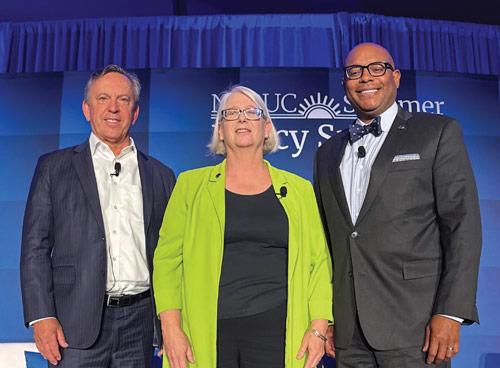
Moderator and NARUC President Ann Rendahl: I’m going to have a conversation with utility CEOs to share their perspectives on investing in clean dispatchable generation. Talk about your utility’s clean energy goals and how those goals are evolving to meet growing electricity demand, while maintaining reliability and affordability.
NYPA CEO Justin Driscoll: Our goals are the state’s goals because we’re an arm of the state. We’re a quasi-governmental entity; public power, of course. We’re a G&T company. We don’t have any retail customers.
We’re a tool in the state’s toolkit to implement its energy policy. We’re looking to decarbonize the state. It’s a tricky state to decarbonize because we have the tale of two grids with upstate almost entirely clean energy between our hydropower and nuclear plants owned and operated by Constellation, and then the New York City area, which is heavily dependent on fossil.