

Market Mechanisms for LDES Investment
Noah Podolefsky is a Ph.D. physicist, innovator and thought leader with over fifteen years in the battery energy storage systems (BESS) space. As a Senior Advisor with Clarum Advisors, Noah leverages his extensive knowledge of the BESS industry and business strategy assisting funds with investment due diligence, large corporations with BESS innovation, and energy storage startups with growth and commercialization strategy.
Molly Podolefsky is a Ph.D. economist and leader in the energy and sustainability industry with experience spanning decarbonization, the utilities and energy sector, finance and investment and business management. As a Managing Director with Clarum Advisors, she leverages her knowledge and experience working with utilities, startups, corporations and funds in the energy transition space.
The past five years have seen an explosion of innovation in the long duration energy storage (LDES) space in response to the rapid expansion of variable renewable energy generation and the need for ever larger tranches of energy storage to firm capacity while displacing fossil generation.
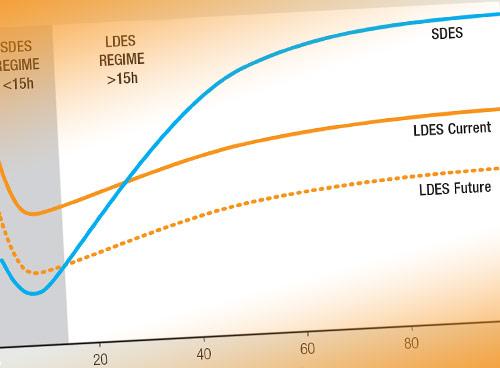
In Part One of this series in March PUF, we explored the current state of LDES, providing a framework based on the needs of customers to identify the set of technologies best positioned for success in this emerging market — carbon dioxide, flow, iron-air and lithium-ion batteries.
Despite the proliferation of novel technologies, LDES has been slow to gain market traction and is still seen as a relatively high-risk investment. Significant barriers to capital investment in LDES technologies remain, hence the persistence of high-cost curves and lagging commercialization. In Part Two of this series, we consider barriers to investment and explore the set of market mechanisms required for LDES to advance.
Barriers to Investment
LDES vs. Modular Substitutes: Given that an array of short duration batteries and a single LDES system can accomplish the same task within a given period of time, the question becomes at what point LDES is more cost-effective.