

Women's History Month
Judy Chang is a Commissioner at the Federal Energy Regulatory Commission, having joined the agency in July 2024. She is an expert in energy economics and policy with more than 20 years of experience advising energy companies, trade associations, and government entities on regulatory and financial matters, including transmission investment and market design. Prior to FERC, she served as Undersecretary of Energy and Climate Solutions for Massachusetts. She has also taught public policy at the Harvard Kennedy School and was a founding board member of New England Women in Energy and the Environment. Chang holds a Master of Public Policy from Harvard and a bachelor’s degree in electrical engineering and computer science from UC Davis.
In recognition of Women’s History Month, PUF sat down with thirteen women leaders across the energy sector to capture their perspectives at a pivotal moment for our industry.
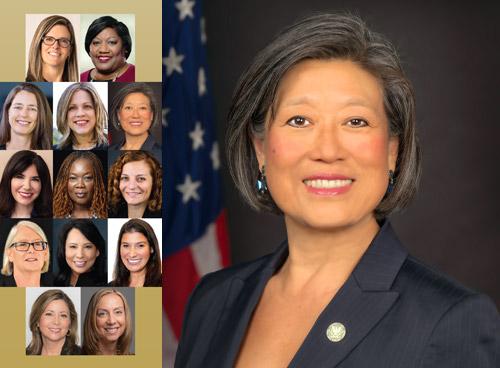
Demand is rising. Infrastructure investment is accelerating. Utilities, regulators, and innovators are navigating increasing expectations around affordability, reliability, and resilience. In this environment, leadership is not theoretical. It is operational. Decisions made today will shape markets, systems, and communities for decades.
The women featured here represent the breadth of the modern grid. Their roles span utilities, regulatory commissions, federal public power, trade associations, research institutions, consumer advocacy offices, and technology companies. The perspectives are varied, but several themes recur: translating complexity into clarity, balancing competing priorities, preparing the workforce of the future, and keeping customers at the center of the conversation.
These conversations are not a single narrative. They are a collection of viewpoints reflecting the realities of leadership in motion. Together, they offer insight into how this essential industry is being guided forward at a time of significant change.
PUF’s Rachel Bryant: Many people do not set out to build careers in regulation, and paths into this work are rarely linear. How did you find your way here?
Commissioner Judy Chang: Looking back, it can almost feel like everything was planned, but it really was not. My career followed a nonlinear path, and I was fortunate to have a number of roles along the way that shaped how I think about this work.
I started in the telecommunications industry, working at AT&T in management and business roles. That experience was formative. I learned how to manage people and teams early in my career, and I also received formal training in negotiation. Both skills have stayed with me.
I later went to graduate school, where my interests began to focus on infrastructure financing, particularly large infrastructure projects in developing countries. I worked in international finance and infrastructure roles, which deepened my expertise in finance and reinforced my interest in large, complex systems.
If there is one thread that runs through my career, it is infrastructure. I have always been drawn to how large systems are built, financed, and governed.
From there, I moved into economic consulting, where I immersed myself in energy economics and finance. Because the energy industry is so heavily regulated, understanding regulation became essential. In many ways, regulation followed naturally from the economic and financial work I was already doing.
My interest in public service solidified during my time working with the Massachusetts state government. That experience reinforced how meaningful the work can be. After a brief return to consulting, I joined the Commission, where my background in economics, finance, infrastructure, and regulation came together.
PUF: How has your approach to leadership evolved over time, particularly during periods of change and uncertainty?
Commissioner Judy Chang: I spend a lot of time thinking about leadership, both in terms of managing a team and leading an organization or institution.
At the team level, I believe the best leaders focus on building complementary teams. It is not about surrounding yourself with people who all think the same way. It is about bringing together different strengths and perspectives and making sure they work well together.

I also think it is essential to create regular opportunities for people to grow. Everyone has aspirations, whether they are early in their career or well established.
A good leader tries to understand what people want to do next, whether that is five or ten years out, and then looks for ways to help them build toward that future. People do not want to feel stuck, and creating a sense of growth and possibility is incredibly motivating.
At a broader level, I have always admired leaders who can look at familiar problems in new ways and inspire people beyond their immediate teams. Those leaders can drive innovation and engage wider communities, whether that is within an organization, across a state, or at the national level.
This role has been a real test of my leadership skills. The issues we face are complex, and the environment is constantly changing. That makes it even more important to be intentional about how you lead.
PUF: You are not a lawyer by training, yet you now serve in a highly legal and regulatory role. How did you think about building the right team around you?
Commissioner Judy Chang: I knew coming into this role that I needed very strong legal advisors. I needed people who could not only advise me, but also help me think through legal precedents, focus on the right materials, and approach decisions in a way that is legally sound.
Once that foundation was in place, I thought about the challenges that are always present in this industry, whether we are talking about transmission, markets, pipelines, or generation. Cost is always at the center. How infrastructure is financed, how returns are structured, and how costs are ultimately allocated to customers are foundational questions in regulation.
I wanted someone on my team who could follow the money. When a dollar is spent on infrastructure, how does that translate into costs for ratepayers? Understanding that connection is critical.
I also built the team around my own gaps. I did not come into this role with experience interacting with Congress, so I knew I needed someone with strength in that area who could advise me and help me learn.
More broadly, I focus on hiring people who are smart, hardworking, and curious. I care more about how someone thinks and articulates their reasoning than whether they already know every detail of an issue. The right people can learn the substance.
Finally, fit matters. Building a team is a bit like casting a play. You want the chemistry to work. We spend a lot of time together, and mutual respect is essential.
PUF: From your perspective, what are the most pressing issues facing the Commission right now?
Commissioner Judy Chang: We are in the midst of a significant shift in the energy industry. After many years of relatively flat electricity demand, we are now seeing substantial growth, much of it driven by very large loads.
This is different from what we have experienced in the past. A single new load, such as a large data center, can be on the order of a thousand megawatts. That scale presents challenges across the system.
There are infrastructure questions about how we finance and build the necessary generation and transmission, where facilities are located, and how they interconnect. There are also important policy questions about how we serve these new customers while continuing to protect traditional, captive ratepayers who have historically paid for system upgrades.
Balancing those interests is one of the biggest challenges before us. There are also reliability and affordability implications. We are making decisions under a great deal of uncertainty about what demand will look like one, three, or five years from now.
Our task is to help the industry plan for the future, while maintaining core principles, including nondiscriminatory access to the transmission system. We must act quickly and thoughtfully. These are not issues ten years away. They are here now.
Every Commissioner is focused on finding the right balance and making decisions that are legally durable and effective. We cannot afford to set rules that do not work and then correct them later. The stakes are simply too high.
PUF: Is there anything else you would like people to understand about this moment at the Commission?
Commissioner Judy Chang: This is a historic moment. For the first time, the majority of Commissioners here are women. Each Commissioner brings a different background and perspective, and that diversity is incredibly valuable given the scale and complexity of the challenges we are facing.
We have big problems to solve, and we have to solve them together. I am proud to be serving at this moment and of the leadership women are providing at the Commission.
Women’s History Month articles at fortnightly.com
- Doseke Akporiaye, WRISE Executive Director
- Hannah Bascom, Uplight Chief Growth and Commercial Officer
- Michele Beck, Utah Office of Consumer Services Director
- Vittoria Bellissimo, CanREA President and CEO
- Judy Chang, FERC Commissioner
- Neva Espinoza, EPRI Senior Vice President, Energy Supply, and Chief Generation Officer
- Sonia Kastner, Pano AI Co-Founder and CEO
- Maria Korsnick, Nuclear Energy Institute CEO
- Tracey LeBeau, WAPA Administrator and CEO
- Michele O'Connell, Orange and Rockland Utilities CEO
- Ann Rendahl, NARUC President
- Melissa Washington, ComEd Senior Vice President
- Alice Yake, Breakthrough Energy Vice President, GRIDS
