

No One-Size-Fits-All Solution
Molly Podolefsky is a Ph.D. economist and leader in the energy and sustainability industry with experience spanning decarbonization, the utilities and energy sector, finance and investment and business management. As a Managing Director with Clarum Advisors, she leverages her knowledge and experience working with utilities, startups, corporations and funds in the energy transition space.
Noah Podolefsky is a Ph.D. physicist, innovator and thought leader with over fifteen years in the battery energy storage systems (BESS) space. As a Senior Advisor with Clarum Advisors, Noah leverages his extensive knowledge of the BESS industry and business strategy assisting funds with investment due diligence, large corporations with BESS innovation, and energy storage startups with growth and commercialization strategy.
The landscape for long duration energy storage (LDES) is complex and rapidly evolving. Pumped hydro storage (PHS), the mainstay of LDES over the last century, requires specific geographic features that have largely been exhausted in many regions. At the same time, the rapid growth of variable renewable energy (VRE) generation through wind and solar requires ever larger tranches of energy storage to firm capacity, ensuring grid reliability and resilience.
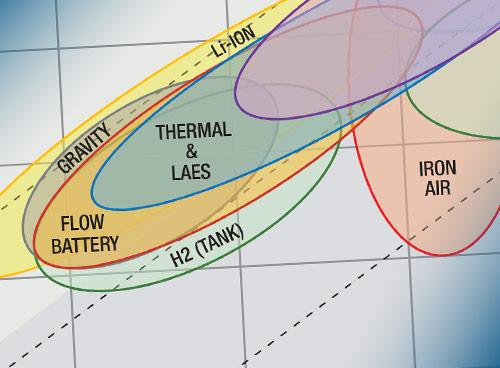
The resulting market need has led to an explosion of creativity in the LDES space, with novel technologies, from R&D to early-stage commercially viable solutions rushing to fill the gap.
The future of this market depends on regulators, buyers, and investors making choices today that will accelerate the market toward an efficient future state, yet the market is complex and rapidly evolving. To untangle this dimensionality, we present a structured framework for analyzing the LDES market today, at the start of 2026.
LDES Technologies and Key Characteristics
Four categories containing over fifty unique solution types comprise the LDES market today:
Mechanical — Pumped hydro, compressed air, liquid air, cryogenic, gravity;